
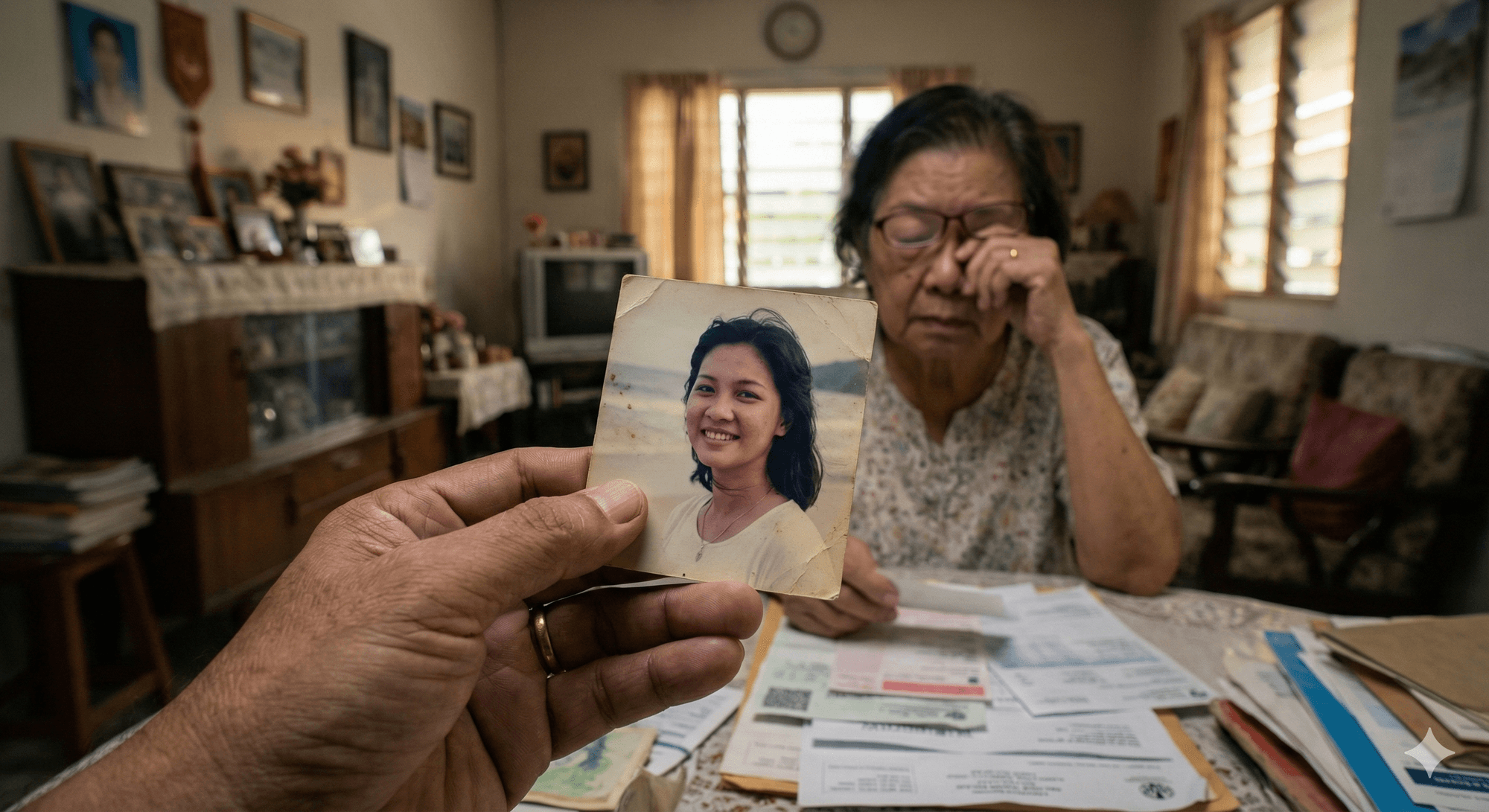
Right Now, I See My Mom as a Person
Prologue
My brain is a browser with too many tabs open.
In the blue light of the early morning, I am scrolling through career roadmaps, LinkedIn success stories, and gym routines that promise to "optimize" my human experience. The Internet is a screaming gallery of people telling me how to live, how to spend, and how to be better than I was yesterday. It is the "hustle"—a high-frequency static that makes me feel like I’m running a race on a treadmill moving just a little too fast.
I was trained to look at the world and see the layers of history hidden beneath the surface. I understand how the crust of the Earth scars and folds under the weight of time. But when it comes to my own life, I am often blind to the ground I am standing on.
The phone vibrates on my desk, cutting through the hum of my laptop fan.
MOM.
I sigh, a sharp exhale of practised frustration. I know how this goes. I pick up, and before I can even offer a "Hello," the Scripture starts. It is usually a verse from the Psalms or Proverbs—honestly, I have spent my whole life training my ears to filter it out like background noise.
"You must remember the Word," she says, her voice carrying that familiar, nagging rhythm that used to make my blood boil during my school years. "You are straying. You are looking for water in broken cisterns."
I let out a short, dismissive laugh. "Mom, I’m just trying to manage my life. I don’t need a sermon right now."
Back then, I would have hung up and scrubbed those words from my brain immediately. I saw her as a person made of Sunday school lessons and rigid rules—a woman who couldn't possibly understand the "complexity" of my modern struggle. To me, she was just Mom. A fixed object. A puzzle piece that didn't quite fit the chaotic picture of my life.
But lately, the static has been clearing.
I have started to look at the way she holds her spine so straight, even when the world tries to bend it. I have started to wonder about the girl she was before she became my mother. The girl who was the "Example" for four younger siblings. The scholar who held a golden ticket to a top university in her hand, only to watch it turn into ash because her family needed bread more than they needed a graduate.
I’ve started to think about the ghosts she carries: the firstborn lost to the floorboards of a workplace she couldn't afford to leave, and the marriage she stitched back together with nothing but a refusal to let her children’s foundation crumble.
I realized that I have been treating her life like a footnote in my own story.
But right now, I am starting to see her. Not as a scolding voice or a collection of verses, but as a person. An architect who sacrificed her own blueprints so I could build my own house.
The static is finally fading. And for the first time, I am quiet enough to listen.
Act 1: Kitchen of The First Born
The phone call ends with a hollow, digital click, leaving a vacuum of silence in my room.
I stare at the screen of my smartphone. A notification pops up: “5 Productivity Hacks for Your Morning Routine.” I swipe it away. Another pings: “Is your gym progress stalling? Check these metrics.” My brain feels like a browser with fifty tabs open, all of them playing audio at once. I feel the familiar thrum of anxiety in my chest—the digital static of a generation obsessed with "optimization." I lean my head back, closing my eyes, trying to force the noise to settle.
The high-pitched whistle of the internet starts to change. It deepens. It turns from a digital hum into the sharp, metallic scream of a boiling kettle.
The blue light behind my eyelids doesn't fade; it stretches and thins until it becomes the grey, pre-dawn light of a morning forty years ago. The smell of my expensive candle is swallowed by the heavy, honest scent of woodsmoke, wet earth, and the metallic tang of a cold stove. I don’t feel like I’m dreaming. I feel like I’ve finally tuned the radio to a frequency that has always been there, hidden under the noise.
I’m standing in a kitchen. The floor is rough concrete, cold enough to ache through the soles of my feet. This is the foundation.
I see her.
She is nine years old, a slip of a girl with a ponytail pulled so tight it looks painful. She is standing on a weathered wooden crate because she is still too short to reach the iron pot. Her hands move with a terrifying, unblinking focus. To her parents, she is not a child; she is a Provider. I watch the grueling, silent choreography of her life: she is the one who scrubs the rice until her fingers prune; the one who kneels over a slab until her knuckles bleed; the one who balances a pole across her thin shoulders to carry the family's survival to the market. There is no "Good morning, sweetheart." There is only the relentless demand of her existence.
Suddenly, the kitchen door swings open. The damp morning air rushes in, carrying a sound that makes her shoulders lock.
It’s a rhythmic
....thwack!!!
Then a cry.
I follow her gaze through the glassless window. Outside, her third sibling—her little brother—is tied to a jackfruit tree. He had skipped class, a small rebellion against the crushing weight of this house. My grandfather stands over him with a stripped bamboo stick.
....thwack!!!
The boy’s legs are streaked with red. He’s screaming for mercy, for his mother, for anyone.
Inside, the girl’s grip on the rice paddle tightens until her knuckles turn ghostly white. A tear wells up in her eye—a tiny, rebellious drop of salt—but she doesn't let it fall. She has already learned the most painful lesson of her life: Feeling is a luxury she cannot afford. If she stops to cry, the system breaks. She suppresses the sob, her face hardening into a wall of iron.
"Be still," she whispers, not to her siblings, but to her own heart.
Her mother walks in, stepping over the girl’s shadow as if it were a stain. She doesn't acknowledge the breakfast already steaming. She just looks out the window at the boy being beaten. "He needs to learn," she says coldly. Then, she drops a heavy basin of wet clothes at the girl’s feet. "The youngest needs a shower. Then the market. Now."
She pauses for a fleeting second. The girl reaches into her waistband and pulls out a crumpled school exam—a perfect 100%. She holds it out toward her mother, her fingers trembling with a hope she hasn't yet managed to kill. It’s a silent plea: See me. Love me for my mind, if you cannot love me for my heart.
Her mother doesn't even glance at it. "The market," she repeats.
The girl’s hand drops. She folds her intelligence back into her skirt—tucking her soul into a dark place where it can't be bruised—and picks up the basin.
But as her mother leaves the room, the stoic daughter vanishes, and the Protector emerges.
The younger siblings gather around her on the low bench, their eyes wide and terrified. The moment the parents are out of sight, she becomes their only sanctuary. She turns to the youngest, whose face is smudged with dirt and tears, and her voice loses its iron edge.
She doesn't just shower him with cold water; she makes it a game, whispering stories of a "Golden University" where the buildings touch the clouds, and no one ever has to be hungry. She is the one who hides the extra bit of scorched rice at the bottom of the pot to slip into their hands. She is the one who mends their clothes by candlelight so they aren't mocked at school.
I watch her go outside to the jackfruit tree after my grandfather leaves. She kneels in the dirt, ignoring the stains on her skirt, and pulls a small tin of salve from her pocket. Her touch is the only soft thing in this entire village.
"Don't cry," she tells her brother, wiping his face with her thumb. "If you cry, they win. If you stay quiet, you keep your soul."
To her parents, she is a servant. But to these four children, she is everything. She realizes that if she collapses, they will be crushed by the same coldness that is freezing her heart. So she decides, right there in the rain, that she will be the fire so they don't have to feel the frost.
She picks up her heavy baskets and begins the long walk to the market, a nine-year-old girl carrying the weight of five lives on her back.
Act II: The Horizon of Gold, Too Far to Reach
I wake up in the middle of the night, my neck stiff against the back of my chair. My laptop screen has gone to sleep, but the power light flickers—a steady, rhythmic amber pulse.
Blink. Blink. Blink.
In my half-conscious state, the amber light begins to expand. It stops being a plastic LED and starts to glow with the warmth of an afternoon sun hitting old stone.
The hum of the cooling fan in my room shifts. It loses its mechanical edge, softening into the rustle of wind moving through ancient trees and the distant, melodic chime of a clock tower.
The transition is effortless, like a record finally finding its groove. I am no longer staring at a black screen. I am standing at a massive iron gate, arched like the entrance to a sanctuary. This is the "Golden Opportunity" that had lived in her whispers in the kitchen—the one she had bought with every 100% score she hid from her parents, every hour of sleep she traded for study.
It is 1980-something. And for a fleeting moment, the grey "Provider" is gone.
In her place is a young woman of eighteen. She is draped in the sunlight of the city, standing on the threshold of a world that feels like it’s made of honey. The campus is a cathedral of light. The sandstone buildings glow, and the library windows reflect a sky so blue it feels like a promise. For the first time, she is surrounded by a life that isn't a burden.
I see her in a seminar. For the first time, she has friends—real friends who see her not as a servant, but as a peer. They sit on the grass, their laughter sounding like bright, gold coins spilling onto the pavement. They value the "Person" that was hidden behind the smoke; they value the mind that can unravel the mysteries of the world. In these moments, she smiles. It is a small, careful thing, but in the light of the university, her smile looks like gold, too.
But the Stoic never truly leaves her.
While her friends spend their afternoons in cafes, she is back in her cramped dormitory, hunched over a desk until her eyes burn. She has a scholarship—a golden ticket that paid for her tuition—but she quickly learns that gold doesn't feed the hungry.
The letters from home arrive like lead weights, dragging her back down into the grey. There are no inquiries about her dreams. Each envelope is a ledger of her parents' expectations.
“You are in the city now,” the letters imply.
"The city is where the gold is. Your siblings are hungry. Do not be selfish with your brilliance while their stomachs are empty. You are our first-born; your duty did not end at the gates.”
I watch a specific afternoon that breaks my heart. Her friends come to her door, glowing with excitement. There is a university gala—a night of music and celebration, a door to the professional "Gold" of the city. They beg her to come. They see her as the top of the class, the guest of honor.
I see the girl in her want to say yes. I see her fingers brush a hand-me-down blouse. But then I see her open her small tin box.
She counts the coins.
After the money for her brother’s tuition and the "emergency" fund her father demanded are set aside, there is nothing left. Not for a dress. Not for a ticket. Not even for a decent meal.
She tells them she’s "busy studying." She watches them walk toward the lights of the great hall from her dark window, looking like stars in the night. She stays in the shadows, her stomach growling, her heart hardening.
She reaches into her bag and pulls out a small, worn Bible.
This is the moment I finally understand the "Nagging."
I watch her fingers trace the lines. She isn't reading it to be "holy." She is reading it because the Scripture is the only thing that tells her that her Gold isn't being wasted. In a world where her parents treat her like a source of revenue, the Word is the only voice that tells her she is a precious daughter of a higher Father. It is her internal scaffolding. It is the iron rod she inserts into her spine so she doesn't collapse.
She whispers the words to herself, the same ones she would later repeat to me through a phone line:
"Let us not become weary in doing good..."
She isn't preaching to me. She is reciting the survival code that kept her heart beating when the people who gave her life were trying to steal her light.
The dream ends as the term finishes. The funds from the village have dried up. The scholarship covers the books, but it cannot stop her siblings' hunger. She packs her single suitcase. Her friends think she is going to a summer internship. They don't know she is going to a factory.
She walks out of the gate for the last time. She doesn't look back. She had touched the gold, but she was forbidden to wear it. She is going back to the grey, buying the four degrees she will never get to hold.
I wake up in the dark, the amber light of my laptop still blinking. I look at my own degree on the wall and see it for what it is: Recycled Gold. I realize that her "nagging" isn't about the Bible. It’s about the fact that she knows how easily the light can be taken away. She is screaming at me to cherish the "Gold" she bought for me with her own silence.
Act III: The Mortar in the Cracks
The amber glow of the university gate fades completely, abruptly replaced by the flickering, sterile glare of a windowless office.
The transition from the cathedral of sandstone to this box of plaster feels like a physical blow. I watch her—no longer an eighteen-year-old on the threshold of a dream, but moving with the stiffened caution of someone older. She wears a practical, grey skirt suit that swallows the sharp edges of her youth.
She sits at a metal desk covered in ledgers. She isn't solving the mysteries of the universe anymore; she is balancing them. Columns of numbers, debits, credits, the endless churn of other people’s wealth passing through her hands. Her brilliant mind has been reduced to a calculator.
I stand over her shoulder. The letters from home still come, but they have changed. They bring news of graduations. Her siblings—the four anchors she carried away from the gates—are walking across stages she will never set foot on. They hold the degrees she bought with her silence. She is the invisible engine driving their lives. I watch her fold one of these letters and place it in her drawer. She doesn't smile. She just nods, a grim acknowledgement that the transaction was successful.
Then, the dream shifts slightly, and the cold office is replaced by the humid air of a small, cramped diner.
She is sitting across from him. My father.
I look at them, trying to find the romance I've seen in movies, the sudden spark that ignites a new life. But that isn't what this is. This is a meeting of two exhausted soldiers calling a truce in the rain.
He is tired, too. He speaks softly, and she listens with that same unblinking focus she used in the kitchen so many years ago. I see why she chose him. He doesn't look at her like she is a utility or a machine. He looks at her like she is a person who simply needs to sit down.
The dream moves quickly through the start of their marriage. It is a quiet time of working together. I see them in a small, rented room, putting their small amounts of money together on a cheap kitchen table. For a short time, her hard, serious face relaxes. I see her laugh at something my father says—a real, honest laugh that fills the small room. For a moment, I think the "Gold" and the happiness have come back.
But the "Provider" doesn't know how to stop.
Even with a ring on her finger, she is still tethered to the village. The demands don't cease. I watch her belly begin to swell with her first pregnancy. But she doesn't slow down. The youngest brother still needs his final semester paid for. The parents still need their allowance. She is carrying her own future, but she is still dragging her past.
I watch her in the office. It is late, and the building is empty except for the low, electric hum of the fluorescent lights. She is rushing—she is always rushing, trying to outrun a debt to her past that never seems to shrink. She stands up to grab a heavy file from the top shelf. She is exhausted, her movements stiff. Her sensible shoes, the ones she has worn for years to save money, have soles worn as smooth as glass.
She turns too quickly.
Squeak.
The rubber sole skids on the polished tile.
Gasp.
A sharp, panicked intake of breath that catches in her throat.
Thud-thud-thud.
The sound of her body hitting the edge of the stairs is heavy and hollow, like wood striking stone
Clatter.
The metal file folders spill out, sliding across the floor like a deck of cards.
Then, there is a sound that is worse than the noise: the rhythmic, mechanical tick-tick-tick of the office clock on the wall, marking time while she lies broken at the bottom of the flight.
I see her in the hospital bed. The sheets are white, so bright it hurts to look at them—a blinding contrast to the grey, dusty life she has lived. The room is silent, except for the steady, cold drip-drip of the IV bag.
She has lost the baby.
The parents who never loved her are not there. The siblings whose degrees she paid for are busy with their own successes, their own lives, their own horizons. She is alone in the middle of a grief that has no name.
This is where the Scripture changes for her. It is no longer just a survival code or a map for the "Example" to follow. It becomes a Lament. I see her clutching the small, worn Bible to her chest, her knuckles white. Her body shakes with a sob—a ragged, wet sound that she refuses to let anyone hear. She is a woman of stone, and even now, she tries to keep the cracks internal.
She is mourning the only thing that was ever truly hers, and not a debt she owed to someone else.
But the world isn't done testing the foundation.
The dream fast-forwards. There are children now—three of us. The house is full, but it is cracking.
I see the "Affair."
It manifests in the dream as a literal shadow in the hallway, a cold wind that blows through the house whenever my father returns late.
The "Person" in her wants to scream.
She has sacrificed her education, her youth, and her first child—and now her husband is giving his heart to someone else.
I watch her stand in the kitchen of our childhood home. She is holding the Bible. She looks at the cracks in the wall, and then she looks at us. She realizes that if she leaves, the house collapses. If she stays, she has to become
The Mortar.
She uses the Scripture like cement, filling the cracks of her broken heart so that we would never have to feel the draft.
Act IV: The Weight of the Pillar
The dream shifts again, settling into a reality I recognize all too well. It’s the house I grew up in.
I see myself as a boy. I am the middle child. On one side is the chaotic, demanding orbit of my hyperactive older brother; on the other, the quiet needs of my younger sister. In this memory, I am always seeking a quiet corner, trying to be seen without causing a disruption.
I watch my younger self looking at my mother. I see the resentment in my own eyes.
To me, back then, she was impossible. She was a wall of stone. When she looked at me, she didn't see a boy needing comfort; she saw a blueprint. She saw a Pillar.
I watch the memories replay—the times she scolded me for a slightly lowered grade, the times she pushed me to study harder, the times she dismissed my complaints with a sharp verse from Proverbs. I felt invisible, crushed under the weight of her demands. Why was she so hard on me? Why couldn't she just be soft?
But viewing it now, outside of my own head, the perspective changes. I am finally seeing the context of her harshness.
For a time, the family is wealthy. The "Gold" she had chased finally seemed to settle in the house. There is a boutique. There are comforts. But it is a fragile prosperity, built on shifting sand.
Then, the ground gives way. The business deals go sour. The scams hit. The foundation she worked so hard to patch together begins to violently tear apart.
Bankruptcy.
I watch the house empty out. I see the fear in my father’s eyes, the panic of a man who has lost everything.
But I watch my mother. The "Stoic" doesn't flinch. She has been here before. She knows what it takes to survive when the world stops loving you.
The dream shows the contrast, sharp and brutal. One week, we are comfortable. The next, she is in the dust.
I see her strapping boxes to the back of a worn-out motorcycle. She is selling food, door-to-door.
I watch her navigate the chaotic, exhaust-choked streets of the city. She is the former Top Student, the brilliant mind who once held the "Golden Opportunity," now knocking on doors to sell cheap meals. She takes the leftover clothes from her bankrupt boutique and tries to peddle them in the blistering heat of the markets.
When that isn't enough, the dream shifts to the sterile aisles of a local department store.
She puts on the cheap uniform of a cashier. She stands behind the register, her back straight, scanning items for people who don't look at her, people who don't see the scholar, the provider, the grieving mother. They just see a set of hands bagging groceries.
She works until her feet swell and her hands ache, bringing home every wrinkled bill so that we can eat. So that I can study. So that the University Gate doesn't close on us the way it closed on her.
I look at the boy I was in the dream, sulking in the corner because my mother was "too strict."
And then I look at her behind the register at the department store, swallowing her pride every single hour so I could have a future.
I realize that she wasn't hard on me because she didn't love me. She was hard on me because she knew exactly how brittle the world was. She needed me to be a Pillar because she knew what happened when the roof fell in. She was forging me in the only fire she knew—the fire of absolute endurance.
She wanted me to have the strength to hold the Gold when I finally reached it.
Act V: The Awakening
I wake up.
The room is silent. The amber light on my laptop is steady now.
The "Hustle" of my own life—the gym routines, the career roadmaps, the digital noise—feels like a thin, pathetic vapour.
I think about the times I judged her for being "too religious," "too strict," or for pushing me too hard. I didn't see the war she was fighting. I didn't see the blood on the mortar or the sweat on the motorcycle handles.
I realize that her "nagging" about the Word of God was her way of telling me:
"This is the only thing that kept the roof over your head when the world tried to blow the house down."
I pick up my phone. It’s late, but I know she’ll be awake. The "Provider" rarely sleeps.
I hit dial.
She answers on the second ring. "Yes?" Her voice has that familiar edge, ready to dispense advice or a verse.
"Mom," I say. My voice breaks, just slightly.
I don't dismiss her. I don't wait for the scolding.
"Mom," I say again. "Tell me about the university. Tell me about the first thing you wanted to build before you had to build us."
The line is quiet for a long time. The static is completely gone.
Right now, I see my mom as a person. And for the first time, I am quiet enough to listen.